


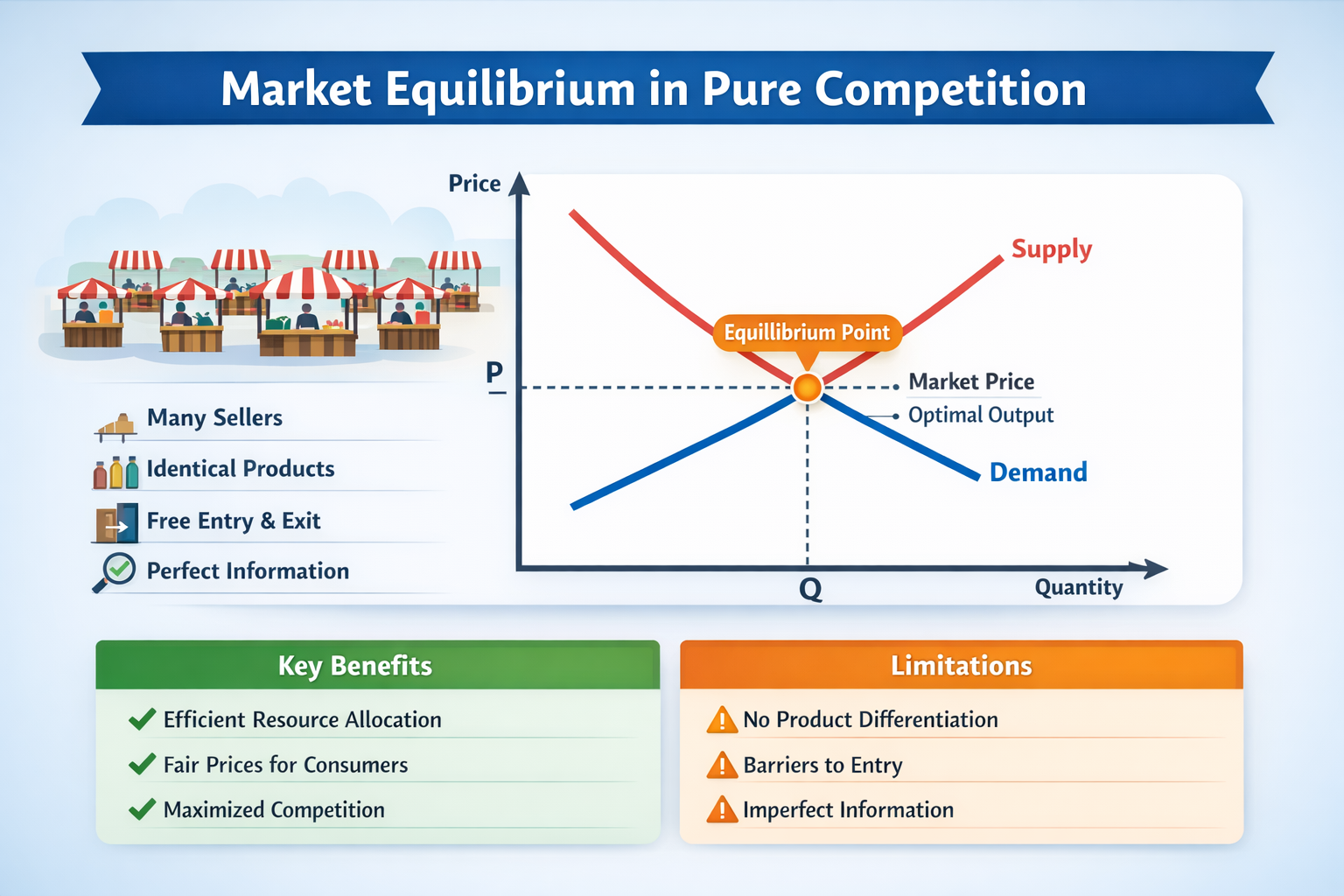
Pure competition, also known as perfect competition, is the most ideal form of a market structure in economics. It describes a situation where a large number of small firms compete against one another by selling identical or homogeneous products. In this type of market, no single firm has enough power to influence prices because the forces of supply and demand determine the market equilibrium. Buyers and sellers possess complete information, meaning there is full transparency in pricing, quality, and production costs. The concept of pure competition is used as a theoretical benchmark to analyze the performance, efficiency, and fairness of real-world markets. By understanding pure competition, economists can assess how closely actual markets approach this ideal efficiency model.
Core Characteristics of Pure Competition
In a purely competitive market, several key characteristics distinguish it from imperfect markets such as monopolies or oligopolies. The first major characteristic is the presence of many buyers and sellers. Each participant’s market share is so small that no one can manipulate the overall price. The second defining feature is homogeneous products, meaning all goods offered in the market are identical and interchangeable. Third, there is free entry and exit, allowing firms to join the market when they see profit opportunities and leave when profits decline. Another essential trait is perfect information — all participants know about prices, demand, and production methods. Lastly, there is no government interference, which ensures that the market remains self-regulating. These combined features create the foundation of pure competition, ensuring transparency, fairness, and economic efficiency.
How Price and Output Are Determined in Pure Competition
In a purely competitive market, prices are determined solely by the interaction of demand and supply. Since each firm produces a small fraction of the total output, it has no control over the market price. All firms are therefore price takers — they must accept the market price as given. If a firm attempts to charge more, buyers will instantly switch to competitors offering the same product at a lower price. On the other hand, selling at a lower price results in losses since the firm cannot recover production costs. The equilibrium price is set where the market’s total supply equals total demand, ensuring that all goods produced are sold. This mechanism guarantees efficiency and fairness, which is the core essence of pure competition. Firms earn only normal profits in the long run because new entrants drive economic profits toward equilibrium.
Short-Run and Long-Run Equilibrium in Pure Competition
In the short run, firms in pure competition can experience three types of profit outcomes — supernormal profit, normal profit, or loss. When the market price is higher than the average cost of production, firms earn supernormal profits, attracting new competitors. As new firms enter, supply increases, pushing prices downward. Conversely, when firms incur losses, some exit the market, reducing supply and raising prices again. This process continues until long-run equilibrium is reached, where firms produce at the lowest possible cost and earn zero economic profit. This dynamic adjustment ensures that pure competition remains a self-correcting system. It promotes productive efficiency, where goods are produced using the least-cost combination of resources, and allocative efficiency, where the price equals marginal cost.
Advantages of Pure Competition
The advantages of pure competition are extensive and contribute to both consumer welfare and economic growth. One of the main benefits is price efficiency, as prices remain stable and reflect actual market conditions. Consumers enjoy low prices and high-quality goods because firms must minimize production costs to survive. Another advantage is resource efficiency — firms produce exactly the quantity demanded at the equilibrium price, ensuring no overproduction or wastage. The model also encourages innovation in production methods rather than in product differentiation. Furthermore, transparency ensures fairness, as all market participants have equal access to information. Overall, pure competition leads to maximum consumer satisfaction, optimal resource allocation, and a balanced economic system.
Disadvantages and Limitations of Pure Competition
Despite its advantages, pure competition rarely exists in reality. One of its biggest limitations is that it assumes identical products, which is almost impossible in modern markets where branding, design, and features create differentiation. Another limitation is the assumption of perfect information, which does not hold true as consumers and producers often lack complete market knowledge. Additionally, barriers to entry such as patents, capital requirements, and regulations restrict new firms from freely entering or leaving the market. The model also ignores externalities like pollution or innovation spillovers, which affect real-world outcomes. Moreover, pure competition does not encourage product variety or brand loyalty, which are essential in consumer-driven markets. Therefore, while the theory is useful for understanding efficiency, it is rarely found in its pure form in practice.
Real-World Examples of Pure Competition
Although true pure competition is theoretical, certain industries come close to it. Agriculture is a classic example — thousands of farmers produce identical crops like wheat, corn, or rice, and no single farmer can influence the market price. Similarly, foreign exchange markets function in a highly competitive manner, where prices (exchange rates) are determined purely by global demand and supply forces. Stock markets also reflect elements of perfect competition, as buyers and sellers operate with full price transparency and rapid information flow. These examples show that while perfect competition doesn’t exist in its absolute form, its principles significantly shape modern market dynamics, ensuring competitiveness and fairness across sectors.
Relevance of Pure Competition in Today’s Economy
In today’s globalized and digital economy, pure competition continues to serve as a guiding framework for economists and policymakers. It acts as a benchmark to evaluate market efficiency, consumer satisfaction, and price fairness. Businesses use its principles to improve cost management, transparency, and operational efficiency. The rise of e-commerce and digital marketplaces has made pricing more transparent and competitive, bringing real markets closer to the ideal of pure competition. Furthermore, understanding this model helps governments design antitrust policies that prevent monopolies and encourage open competition. Even though perfect competition rarely exists in practice, its influence on market theory, pricing strategies, and economic regulation remains profound.
FAQs
- What is pure competition in economics?
Pure competition is a theoretical market model where many small firms sell identical products under conditions of full transparency and free market entry. - What are the main characteristics of pure competition?
It includes many buyers and sellers, homogeneous products, perfect information, and freedom of entry and exit. - Does pure competition exist in real life?
Not completely, but agricultural and foreign exchange markets come closest to this structure. - Why is pure competition important?
It serves as a model for understanding efficiency, fair pricing, and consumer welfare in the economy. - What are the advantages of pure competition?
It promotes efficiency, transparency, fairness, and the best possible use of economic resources.
Conclusion
Pure competition represents the most efficient, transparent, and fair form of market structure in economics. It ensures that consumers get the best products at the lowest possible prices and that producers operate at maximum efficiency. While it may be a theoretical model, its principles continue to guide modern markets toward fairness, innovation, and sustainability. Understanding pure competition helps economists, policymakers, and business leaders create systems that reduce monopolistic power and promote equality in economic opportunity. In essence, pure competition is not just a market theory — it’s the foundation of economic justice, equilibrium, and growth.
