


Understanding how to convert numbers into percentages is an important skill used in education, statistics, business, and everyday decision-making. Many people search online to learn how to calculate 9 out of 12 as a percentage because percentages make comparisons easier to understand. When a value is expressed as a percentage, it shows how much one number represents out of a total of 100. This makes data easier to interpret in tests, surveys, reports, and performance evaluations. Converting fractions to percentages also helps simplify complex numbers into a universal format used worldwide. In this detailed guide, we will explain how to calculate 9 out of 12 as a percentage, the formula behind the calculation, practical examples, and why this conversion is useful in real life.
Understanding the Concept of 9 Out of 12 as a Percentage
The phrase 9 out of 12 as a percentage represents a fraction where 9 is the portion of the total and 12 represents the complete value. Fractions show relationships between numbers, but percentages provide a clearer interpretation because they express the result out of 100. When we convert 9 out of 12 as a percentage, we are essentially asking how much 9 represents compared to the total value of 12 on a scale of 100. This type of calculation is widely used in grading systems, performance tracking, surveys, and financial analysis. Many educators and analysts prefer percentages because they allow quick comparisons between different datasets. Understanding 9 out of 12 as a percentage helps individuals interpret numerical results more effectively.
Step-by-Step Method to Calculate 9 Out of 12 as a Percentage
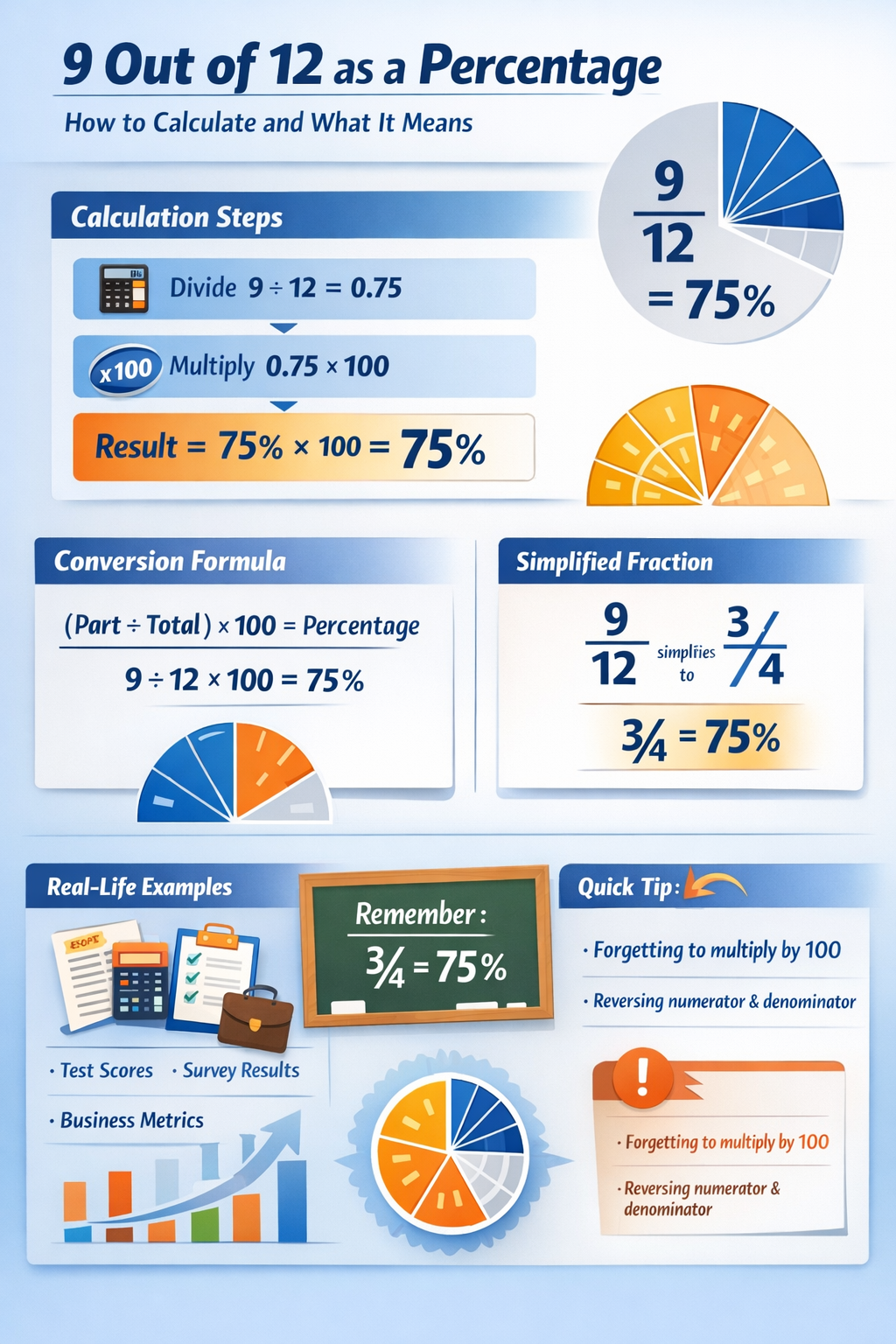
Calculating 9 out of 12 as a percentage involves a simple mathematical process that can be completed in just a few steps. First, we convert the fraction into a decimal by dividing the numerator by the denominator. In this case, dividing 9 by 12 results in 0.75. After obtaining the decimal value, the next step is converting it into a percentage by multiplying the decimal by 100. When 0.75 is multiplied by 100, the result becomes 75%. Therefore, the final answer is that 9 out of 12 as a percentage equals 75%.
This step-by-step process is widely used in mathematics and statistics because it works for any fraction. By understanding how to calculate 9 out of 12 as a percentage, you can easily convert other fractions into percentages as well. This skill is useful in academic exams, business reports, and everyday numerical analysis.
The Standard Formula for Converting Fractions to Percentages
Whenever you want to convert a fraction like 9 out of 12 as a percentage, you can use a simple and reliable formula. The formula is:
Percentage = (Part ÷ Total) × 100
Using this formula makes it easy to calculate percentages quickly and accurately. When we apply the formula to 9 out of 12 as a percentage, we divide 9 by 12 and then multiply the result by 100. The outcome of this calculation is 75 percent. This formula is commonly used in mathematics classes, statistical reports, and performance evaluations.
Learning this formula helps people convert many other fractions into percentages without difficulty. For example, values like 4 out of 8, 7 out of 10, or 15 out of 20 can all be converted using the same method. By mastering this formula, calculating 9 out of 12 as a percentage becomes simple and efficient.
Simplifying the Fraction Before Converting to a Percentage
Another helpful way to calculate 9 out of 12 as a percentage is by simplifying the fraction first. The fraction 9/12 can be reduced by dividing both numbers by their greatest common divisor, which is 3. After simplification, the fraction becomes 3/4. Simplifying fractions can make calculations easier and faster.
The fraction 3/4 represents three equal parts out of four total parts. When converted into percentage form, it equals 75%. This confirms that 9 out of 12 as a percentage is indeed 75 percent. Simplifying fractions is a useful strategy in mathematics because it reduces complex numbers into easier forms. It also allows people to perform quick mental calculations without using a calculator.
Real-Life Examples of 9 Out of 12 as a Percentage
Academic Test Results
One of the most common situations where 9 out of 12 as a percentage is used is in education. Imagine a student answers 9 questions correctly out of a total of 12 questions on a quiz. By converting the score into a percentage, the result becomes 75%. Teachers often use percentages because they provide a clearer representation of student performance. A score of 75 percent generally indicates a good understanding of the subject. Students can quickly assess their results when grades are expressed in percentages rather than fractions. This is why knowing how to calculate 9 out of 12 as a percentage is helpful for academic success.
Survey Results and Data Analysis
Another real-world example of 9 out of 12 as a percentage can be seen in surveys and research studies. Suppose a company conducts a survey with 12 participants and 9 of them agree with a certain opinion. When converted into a percentage, this means 75% of participants support that view. Presenting data in percentages makes it easier for readers to understand research findings. Businesses and analysts rely on percentages to present statistics clearly. Understanding 9 out of 12 as a percentage helps researchers communicate data in a simple and meaningful way.
Business Performance Metrics
Businesses often measure productivity and efficiency using percentages. For example, if a team completes 9 tasks out of 12 assigned tasks, their completion rate would be 75%. Managers use percentages to track performance and evaluate progress toward goals. Converting results like 9 out of 12 as a percentage helps organizations identify strengths and areas for improvement. This type of calculation is common in project management, sales analysis, and operational reporting.
Common Mistakes When Calculating Percentages
Although calculating 9 out of 12 as a percentage is simple, some common mistakes can occur during the process. One frequent error is forgetting to multiply the decimal result by 100. Without this step, the answer remains a decimal rather than a percentage. Another mistake is reversing the numerator and denominator, which changes the final result entirely. Some learners also struggle with decimal division, which can lead to incorrect answers.
To avoid these mistakes, it is important to follow the formula carefully and check each step of the calculation. Practicing conversions like 9 out of 12 as a percentage helps improve accuracy and confidence in mathematical calculations.
Quick Mental Math Trick for 9 Out of 12 as a Percentage
There is an easy mental math shortcut for calculating 9 out of 12 as a percentage. Instead of dividing 9 by 12 directly, you can simplify the fraction to 3/4. Many people already know that three-quarters equals 75 percent. By recognizing this relationship, you can determine the percentage instantly without performing a full calculation.
Mental math shortcuts are especially useful in exams, quick data analysis, or everyday calculations. Knowing that 9 out of 12 as a percentage equals 75% allows you to respond quickly and confidently when dealing with similar numerical problems.
(FAQs)
1.What is 9 out of 12 as a percentage?
9 out of 12 as a percentage equals 75%. This result comes from dividing 9 by 12 and multiplying by 100.
2.How do you calculate 9 out of 12 as a percentage?
To calculate 9 out of 12 as a percentage, divide 9 by 12 to get 0.75 and then multiply by 100 to obtain 75%.
3.Can the fraction 9/12 be simplified?
Yes, the fraction can be simplified to 3/4, which is equal to 75%.
4.Is 9 out of 12 considered a good score?
Yes, 9 out of 12 as a percentage equals 75%, which is generally considered a good or above-average result in many grading systems.
Conclusion
Understanding 9 out of 12 as a percentage is a simple but valuable mathematical concept that can be applied in many areas of life. By dividing 9 by 12 and multiplying the result by 100, we determine that the percentage equals 75%. This conversion helps make fractions easier to interpret and compare across different contexts. From academic test scores to survey data and business performance metrics, percentages are widely used to present information clearly. Once you understand the process behind 9 out of 12 as a percentage, calculating other fractions becomes quick, accurate, and easy.
